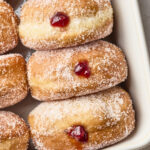
Homemade Jelly Donuts (dairy free!)
Making homemade jelly donuts is easier than you might think, and this dairy free version of the classic Polish paczki - fluffy yeasted donuts fried to golden perfection, rolled in generous layer of granulated sugar and stuffed with tart raspberry filling - are the perfect way to celebrate Fat Tuesday.
Servings: 12 donuts
Ingredients
For the donuts:
- 2 3/4 cups all-purpose flour 330g
- 1/4 cup granulated sugar 50g
- 1 packet instant yeast 2 1/4 teaspoons
- 2 tablespoons dairy free butter melted and cooled
- 2/3 cup dairy free buttermilk heated to 115°F (can substitute canned coconut milk)
- 1 large egg
- 1 egg yolk
- Vegetable oil or shortening for frying
For filling and topping:
- 1 - 1 1/2 cups seedless raspberry jam or pie filling
- 1/2 - 1 cup granulated sugar for coating
Instructions
- Prep the wet ingredients. In a small microwave safe bowl, melt the dairy free butter and set it aside to cool. Then, measure your dairy free buttermilk and microwave for 45 seconds to bring it to about115°F. If it gets hotter than 120˚F, allow it to cool before using or it will kill the yeast.
- Make the dough. In the bowl of a stand mixer fitted with the dough hook, whisk together the flour, yeast, and sugar until evenly distributed. Next, add the dairy free buttermilk, melted butter, eggs, and vanilla extract, mixing until combined.
- Knead the dough. Leaving the mixer on low, allow the hook to knead the mixture for about 5 minutes total, or until the dough is smooth and elastic. The dough should be slightly sticky, but if needed, add about 1/4 cup (30g) of flour at a time until the dough begins to pull away from the bowl.
- First proof. Transfer the dough to a lightly greased mixing bowl, cover with a clean kitchen towel or plastic wrap. Allow the dough to rise in a warm place for 1 to 1.5 hours, or until doubled in size. Rise time will vary depending on room and temperature conditions.
- Roll and cut the donuts. Working on a lightly floured surface, use a rolling pin to roll the dough to about 1/2-inch thickness. Then, use a 3.5-inch donut cutter to cut out donuts.Re-roll scraps and continue to cut doughnuts until you get 12. Place each donut on a 4"x4" parchment paper square on a baking sheet.
- Second proof. Cover and allow the donuts to proof again for about 30-60 minutes or until the donuts look doubled in size. Rise time will vary depending on room and temperature conditions.
- Fry the donuts. Heat 2-3 inches of cooking oil in a large Dutch oven or deep frying pan over medium heat until the oil reaches 340-350˚F. Then, working in batches of 3 donuts, carefully drop your donuts into the oil removing the parchment using tongs after about 10 seconds.Fry for about 1 to 2 minutes per side, or until lightly golden brown, using a spider strainer or slotted spoon to flip and remove them. Transfer the cooked donuts to a cooling rack set over a baking sheet. Repeat until all the donuts are cooked, adjusting heat as needed to maintain oil temperature.
- Roll in sugar. Place the granulated sugar in a shallow bowl. While the donuts are still slightly warm from frying, roll each donut in the sugar to coat all sides. Transfer to a cooling rack and allow them to cool completely before filling.
- Fill the donuts. Transfer the jelly to a piping bag fitted with a Bismarck tip (long piping tip). Insert the tip into the side of each donut, getting the tip as close to the center as possible. Then, gently fill the donut until you see the donut begin to expand. Repeat as needed until all donuts have been filled.