



Why I love pork osso buco
January was a pretty gloomy month this year – I’m sure it has something to do with the post holiday blues and the weather. But, this pork osso buco has brought me back from the darkness, because it is nothing short of perfection. I originally made this dish for my Friday Night Dinner series, a tribute to the food of Gilmore Girls, and I’ve been loving it ever since.
If you like this savory pork recipe, you have to try these baked stuffed pork chops and these glazed pork chops and this smothered pork chops with gravy.
Follow this meal up with a Gilmore Girls inspired dessert: chocolate pudding / baked alaska / blueberry shortcake / apple tarts
Ingredient notes:
- Pork shanks – I got my pork shanks, which are also called fresh pork hocks, at the butcher. They are super long and huge, so I asked them to cut them in half so they would more more “osso buco” in style. It took me a while to find pork shanks, but it was really just a matter of calling around to find them. If you can’t find them in store you definitely find them at an online butcher.
- White wine – Don’t forget that not all wine is dairy free! Read more about it in my article about vegan wine. We used a sauvignon blanc in this recipe, but any dry white wine that you like will work great.
Making changes to a recipe can result in recipe failure. Any substitutions listed are simple changes that I believe will work in this recipe, but results are not guaranteed.


The following is a detailed overview of the recipe steps with added tips and tricks for recipe success. For a simplified and printable version, including ingredient amounts and more formal instructions, see the recipe card below.
How to make pork osso bucco
Prep the pork shanks. Start by tying your pork shanks with kitchen twine. You don’t have to do this, but as the meat braises, it will eventually start to fall apart and it will be harder to serve.
Cut two lengths of kitchen twine per shank and wrap it around the meat – as pictured – tying it as tightly as you can. You want it to be tight so that the strings will stay tight even as the pork shanks shrink while they’re cooking.
Then, liberally season the pork with salt and pepper. Don’t go easy on this, this is your only chance to season the meat and each pork shank is big, so you need a lot!
Sear the meat. Heat your biggest pot to medium-high. Let it get nice and hot then add the pork shanks and sear them until they’re golden brown and slightly crispy. You will probably want to work in batches so you have lots of space to encourage browning.
You shouldn’t need oil for this because the pork is already fatty enough. If you’ve seared the pork well, it will release on it’s own. When they’re browned on all sides, remove the seared shanks and set them aside on a plate.


Sauté the vegetables. Leave any rendered fat in the pan and add the olive oil. Allow it to warm up and sauté the onion, celery and carrots with a pinch of salt. Stir them as needed, cooking until the onions have softened, about 5 minutes.
Simmer until tender. Add the tomato paste and white wine to the pot and deglaze all the flavorful brown bits from the bottom and sides. Then, add the herbs and chicken broth.
Return the pork shanks to the pot and put the lid on. Bring it to a low boil and reduce the heat to low. Let the osso buco simmer for about 3 1/2 hours. I usually start checking at about hour three.
At this point, the pork should be starting to fall off the bone and super tender. Remove the lid and allow the sauce to thicken for the final 30 minutes of cooking.
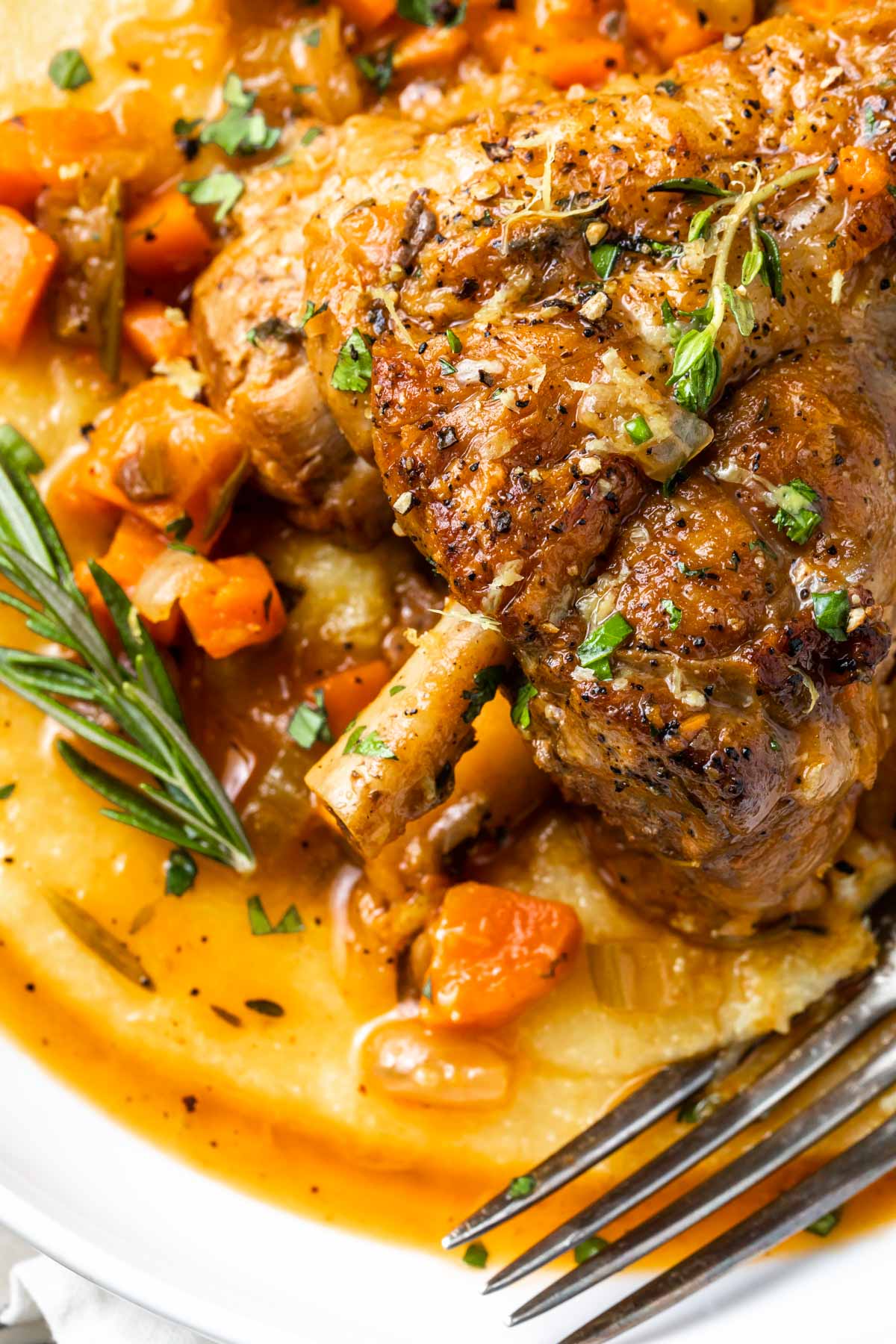
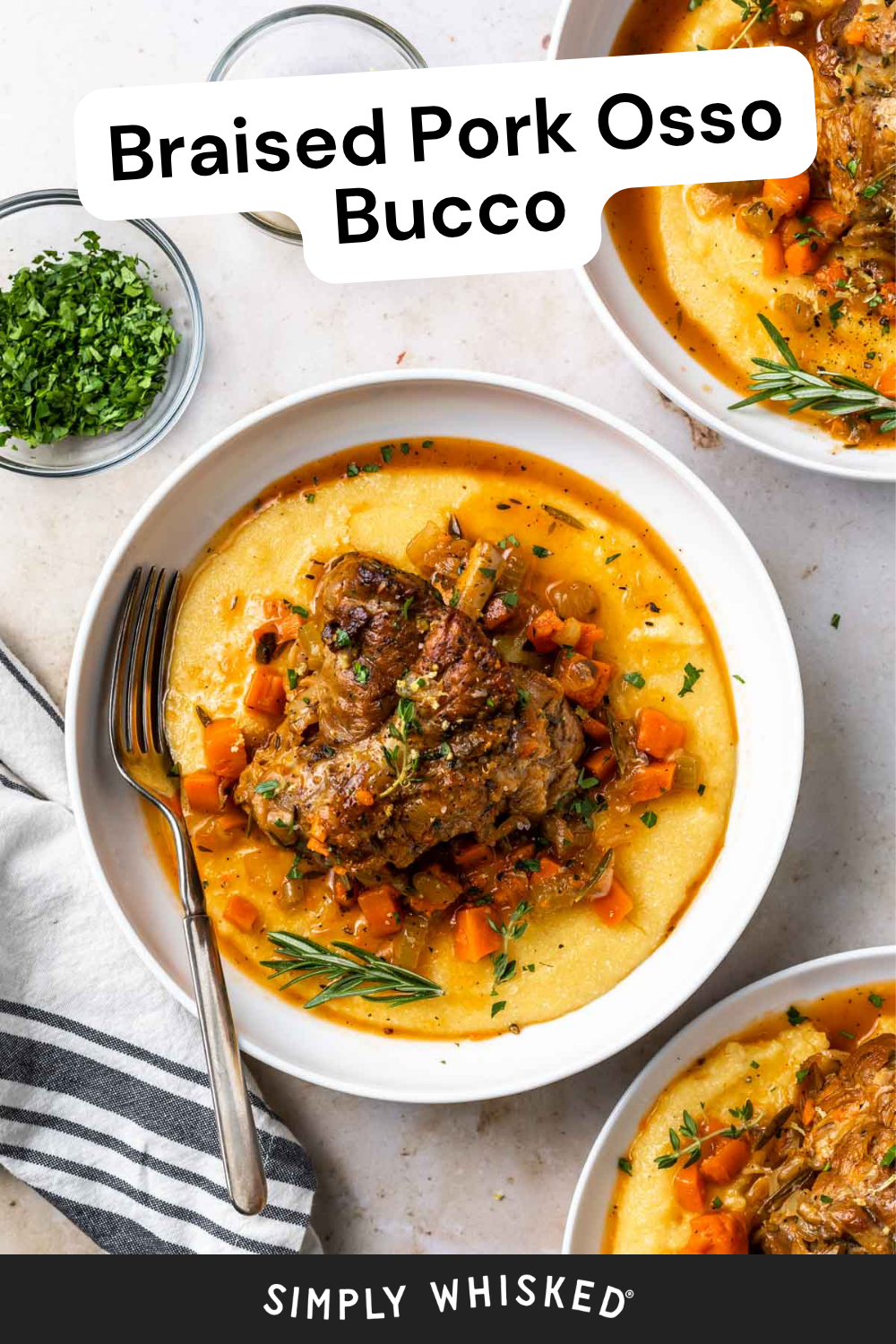
Garnish and serve. I served my pork osso bucco with a simple gremolata – really just a garnish of lemon zest and fresh parsley – and simple creamy polenta. You could totally do mashed potatoes, but you’ll definitely want a side that goes well with gravy/juices because there’s a crazy amount of flavor there.

Frequently asked questions
Osso buco is traditionally made with veal shanks. However, oxtail and beef shanks are commonly used, and this recipe uses pork shanks (aka pork hocks) instead of veal. Beef short ribs are also a cut of meat that is used as a common substitution.
Osso buco means bone hole in Italian – referring to the marrow inside the veal shanks that are typically used in osso bucco. However, the dish itself has become well known and is often used to refer to the cooking method, regardless of the type of meat used.
Yes. You can absolutely eat the marrow from osso buco. It’s full of flavor and contributes so much to the dish. In many ways, this part of the dish is considered the delicacy, and part of why it is considered to be such a fancy meal.
Although they aren’t technically the same thing, I have found that many butchers use the terms interchangeably. Pork hocks tend to be smoked and sold as ham hocks, so if you’re shopping for shanks, and can only find hocks, they will work as long as they are fresh and not smoked.


Braised Pork Osso Bucco
Ingredients
- 4 – 6 pork shanks
- Salt & pepper
- 1 medium onion, chopped (about 1 cup)
- 2 celery stalks, chopped (about 1/2 cup)
- 2 carrots, chopped (about 1/2 cup)
- 2 tablespoons tomato paste
- 1 cup white wine
- 1 1/2 cups chicken broth
- 2 sprigs each: fresh rosemary and thyme
- 1 bay leaf
- Zest from 1 lemon, for garnish
- 1/4 cup chopped fresh parsley, for garnish
Instructions
- Season the shanks with salt & pepper. Brown the shanks until golden and crispy. Remove from pan.
- Add olive oil, onion, celery, carrots and a pinch of salt. Sauté stirring occasionally, until onions are translucent and vegetables have softened – about 5 minutes.
- Add wine and tomato paste, deglazing the pan. Add the chicken broth and return the pork shanks to the pan.
- Cover and bring to a low boil, then immediately reduce the heat to love and simmer for 3 – 3.5 hours. Remove lid for the final 20 – 30 minutes to thicken the sauce.
- Discard the bay leaf and herb stems, and garnish with lemon zest and fresh parsley before serving.
Nutrition
Nutrition information is automatically calculated, so should only be used as an approximation.
Like this? Leave a comment below!










This was restaurant worthy to say the least. Extremely simple yet a bit elegant. I love the fact that there aren’t 20 ingredients and the pork is the star of the dish with a great flavor profile. My boyfriend was very impressed and this would be a great dish to serve for a family gathering. The pork hocks were so cheap as well which was the icing on the cake for me. They were a pretty good size and were only $2.50 each. Winner all day in my book!
Is on the stove right now! I searched your site for this creamy polenta recipe & came up short. I’ve never made polenta before so was hoping I could find your suggestions for it.
Can I substitute the wine with another cup of chicken broth? Or any other suggestions?
Yes totally!
It was awesome! I serve 12 but my hog only had 4 feet, so I had to cut them small. Today we will have store-bought shanks. Cross my fingers. BTW, I’m from Louisiana, so I served it over white rice, and will again.
Bravo!
This looks outstanding but could it be finished in an oven rather than the stove top?
Yes it definitely could. I don’t have the exact time, but about 1 hour per pound is the general rule.